
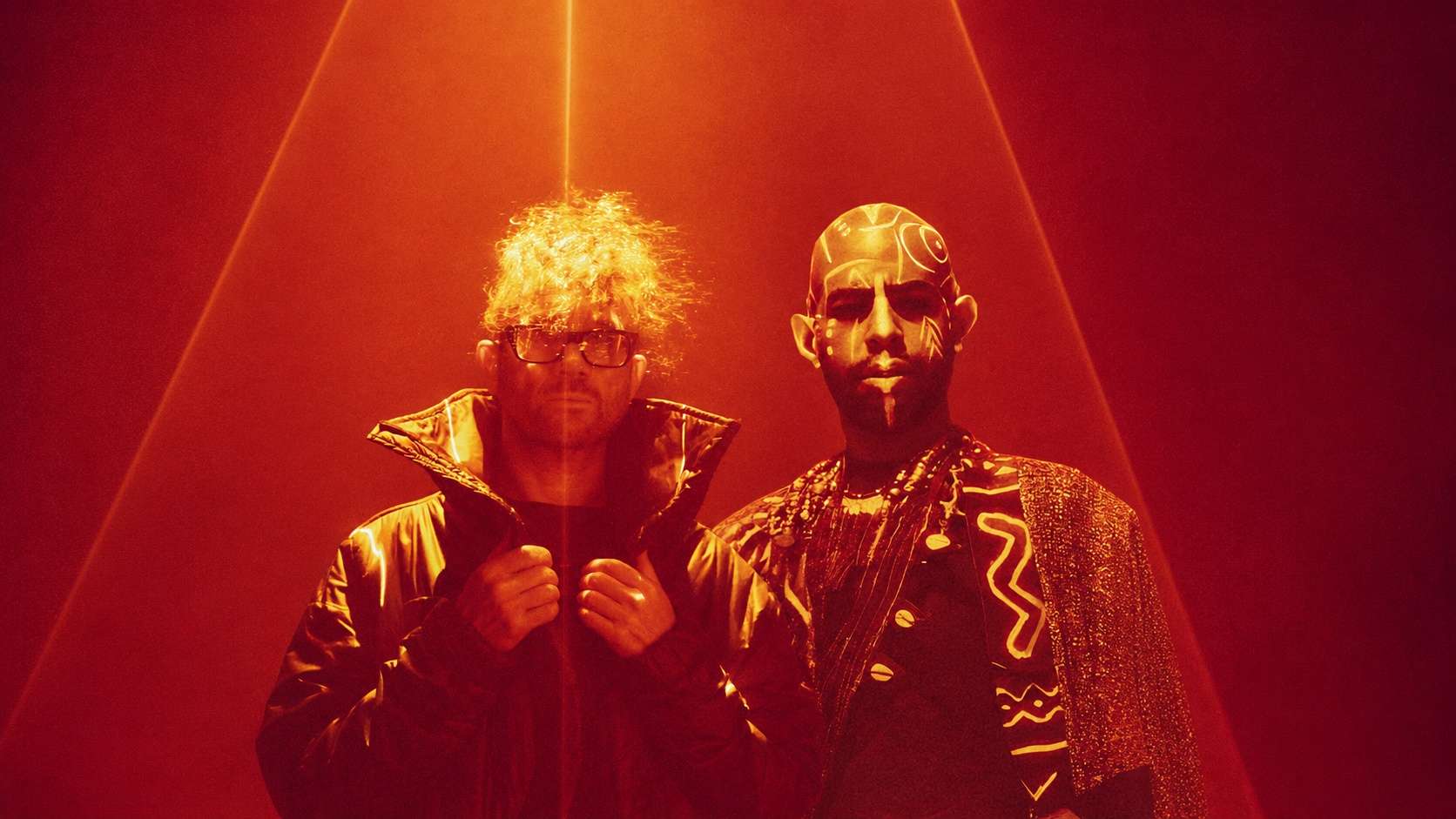
Robot Sunrise and Sean The Star Emperor found the starting point for Dreams from the Solar Underground in a studio session with no fixed agenda.
The vocals recorded that first night survived years of refinement and formed the core of a nine-minute melodic techno collaboration on Robot Sunrise’s second album, There’s Hope.
Behind their forward-looking worlds lies a shared connection to club culture. Robot Sunrise, the project of producer and songwriter Danny Klein, imagines robotic beings seeking freedom; Sean brings cosmic storytelling, theatrical performance and self-expression into electronic pop.
Their meeting point is the dance floor, where inclusion and the freedom to be yourself give those ideas a human purpose.
In this FM PRO 10Q, the pair discuss trusting each other’s instincts, keeping spontaneous performances intact and testing their production at club volume. From first-take vocals to the final mix and master with Jordan Orcaz, they explain how a friendship shaped the record’s sound.
Both of our universes are centered on the dance floor as a means for inspiring connection, a sense of liberation, and celebrating what makes us uniquely human.
— Robot Sunrise
I always want to encourage people to follow their inner desires and stoke the flames of authenticity.
— Sean The Star Emperor

Q1. Dreams from the Solar Underground began with an open-ended studio session. What do you each remember about the moment it started becoming a shared idea?
Sean The Star Emperor: Honestly, I can’t even remember because it was this epic chronicle of a track. I just remember thinking, “I don’t know how we are ever going to make this coalesce into a commercial song”. I felt like it was too unique, or precious even, to the two us for outsiders to understand it. And then, years later, Robot Sunrise says, “I’m tweaking this track…what do you think…okay, it’s going on the album.”Haha.
Robot Sunrise: From the first minute of the first session, we both just allowed the universe to do its thing. Trusting our combined energy. That really was the moment it became a shared idea. Writing like that is a beautiful blueprint for any collaborators willing to let go of time and outside influence.
Q2. The vocals from that first day survived through years of revisions. Sean, what did that original performance capture that you wanted to preserve?
Sean: Haha, not to be ‘Negative Nancy’ again, but I never intended for these vocals to live permanently on this project. It was SUPER scratch. That said, what I love about preserving those vocals is that they still carry the vibration of camaraderie that was so truly alive in the moment we sang them. I feel that energy is imbued into the song, and I absolutely LOVE that idea.
Robot: To add, this track is really a sonic manifestation of our way of being and working. The vocals we sang that first night just appeared without thinking and came together as one–we were letting the artistry do its thing, and the end product is even more special for. It’s a reflection of our shared voices and creative perspective in equal measure, on a cohesively hypnotic cut.

Q3. Robot Sunrise imagines emancipation for AI and robotic beings, while Sean’s universe embraces transformation and self-expression. Where did your worlds connect most naturally on this track?
Sean: Easily, Catch Fire!!! Movements of any kind start with a single flame, and I feel those lyrics piggyback off of Robot Sunrise’s themes. I can’t speak for both of us, but personally, I always want to encourage people to follow their inner desires and stoke the flames of authenticity. In doing so, you can ignite your soul…If not already, then Catch Fire! baby.’
Robot: Totally agree with Sean. “The freedom to be” is a core principle of my artistic ethos, and “catching fire” embodies that spirit perfectly. Both of our universes centre on the dance floor as a way to inspire connection, a sense of liberation, and celebration of what makes us uniquely human. Chasing the things that set your soul ablaze is inherent to our shared artistic visions, the track itself, and the album as a whole.
Q4. You returned to the song over a couple of years. What changed most along the way, and how did you agree it was finally finished?
Sean: It wasn’t so much changes to the track as it was trimmings and prunings—similar to a poodle at a shelter being given grooming so that someone would adopt it. Honestly, I trusted Robot Sunrise completely, so I took a laissez-faire approach. Which was me being a lazy Libra, but he’s a genius, so I knew he’d refine the track in a way that did the music justice. It was so refreshing to not have to “watch the kids” for once (the kids being the song, ha). Usually, I try to oversee everything on the production side when putting out a new track.
Robot: Sean’s energy and creative genius were always in the room with me, even when he wasn’t physically there (which was rare). With every session and every evolution of the track, we always took time to reference it at club volume to really feel what it would “be” on the dance floor. I think that experience is part of why it was so fun to make. It never felt like a process with changes per se, but more like two club kids just having a blast, making music that really hits.
Q5. At nine minutes, the track gives its ideas room to unfold. What made that length feel necessary to the story you wanted to tell?
Sean: The length is SO necessary to let the listener embark on a journey. It is like phonic ayahuasca. Its undulations give way to ego breaks, which then give the listener a subconscious sense of permission to tap into universal truths effortlessly. That’s how it makes me feel, but also is what I’ve observed live from audiences who have experienced the track as well.
Robot: Our first session was boundless, exploratory, went late into the night, and honestly, well into the next morning. We did so much tracking and moment-capturing that every time we got together for another session, it was like, ‘hey, let’s work on this idea’ or ‘hey, look at this gem’. In the end, it all wove itself into the perfect story at exactly the right length.
Q6. The beat gives way to quieter, drifting passages. What do you each want listeners to experience when that dance-floor momentum falls away?
Sean: I’m glad you asked, because it shows you already get it, and it ties into what I mentioned earlier: I want anyone who listens to this track to really have an experience—it is a 360-degree moment. Dreams From The Sonic Underground isn’t just about dancing and casually listening to a beat. More than that, it is about listening to your inner dialogue—the feelings, desires, and failures—and rising above all the “ish” in your life in this moment, so that by the end of the song, you’ve released it. It’s pseudo-religious.
Robot: Yes! Across so many journeys, of many kinds, it’s all about the peaks and valleys. It’s dance music, so there will always need to be long “peaks” with sustained high energy, but that can also be said of the Emperor-Robot world. We want listeners to have time to downshift, to get lost in open expanse and let all of the feels, all the emotions come to life. That creates a beautiful tension, which in turn delivers the final chorus with such a well-deserved release in a truly cathartic way.
Q7. You both describe the dance floor as a place of belonging. What experiences have molded your perception of what makes that space feel welcoming?
Sean: One of the most notable experiences for me was during the latter half of the pandemic. After returning from an extended period of sequestration, it became clear that we desperately needed each other, that our shared communal rituals are essential, and that certain things we thought were trivial pre-pandemic were actually integral to the natural order of humanity. It was beautiful to see that dance spaces, art, musicians, and what they create/cultivate are so immensely valuable to us all.
Robot: I’ve always been a club kid: on the floor, getting lost in the beat, and at one with the dance community. I’ve never really talked much about this, but I was bullied quite a bit as a kid for having crazy hair and, maybe, for just being a “weird artist type”. But the moment I stepped into the club, all of that disappeared. Fast-forward to today, I’m still a club kid on the floor, but I also get amazing opportunities to make and play the music at clubs, festivals, and beyond. That spirit and connection with the community have never left me, and I’m certain it never will.
Q8. – FM PRO TECH: Danny, what was the key recording or processing decision that helped Sean’s first-day vocals sit within the developing production while retaining their original character?
Robot: It was less about decision-making and more about just allowing it to unfold as the universe intended it to. I like to keep the studio process open and easy, with the mic sitting there at all times, ready to be switched on when inspiration hits. So when Sean felt called to share that first vocal, it was automatic and effortless. I think that energy is what made The Emperor’s voice so authentic and unencumbered throughout. From there, having the privilege to work on producing them further was a total dream. It inspired me to track my vocals in response, which was such an incredible infusion of our voices, quite literally, in the music. Everything else just flowed from there.
Q9. – FM PRO TECH: Danny, how did you handle the low end and dynamics throughout the track’s nine-minute arrangement, balancing club impact with room for the quieter sections?
Robot: Picking up on my answer above about periodically listening to the track at club volume—usually at the end of a session, when we knew we’d have time to let our ears rest afterwards—that really helped us arrive at something that delivers a lot of impact across the spectrum. Mixing in real-time, in real-feel. We weren’t just listening—we often found ourselves jumping up and down around the studio—really in it. Once the production was done, from there the final mix and master were in the hands of Jordan Orcaz, who is an absolute genius. He knew exactly what Sean and I were hearing, and captured that perfectly in the final cut.
Q10. What has making Dreams from the Solar Underground taught each of you about the other that you would carry into another collaboration?
Sean: Precision. Robot Sunrise is so purposeful, specific, and detailed. In everything he does, nothing is happenstance or random placement. It was amazing to see the level of detail and nuanced colourings he was attuned to and exhibited through his production. It’s a discipline I would love to carry into all my work henceforth.
Robot: Working with Sean showed me exactly why letting go and trusting shared energy is everything. I’ll always try to bring that approach into everything I do, with whoever I can, all thanks to The Emperor. It takes a special kind of alignment to afford space for something like this to happen, and I’m already super excited for the next Emperor-Robot collab!
©fm