

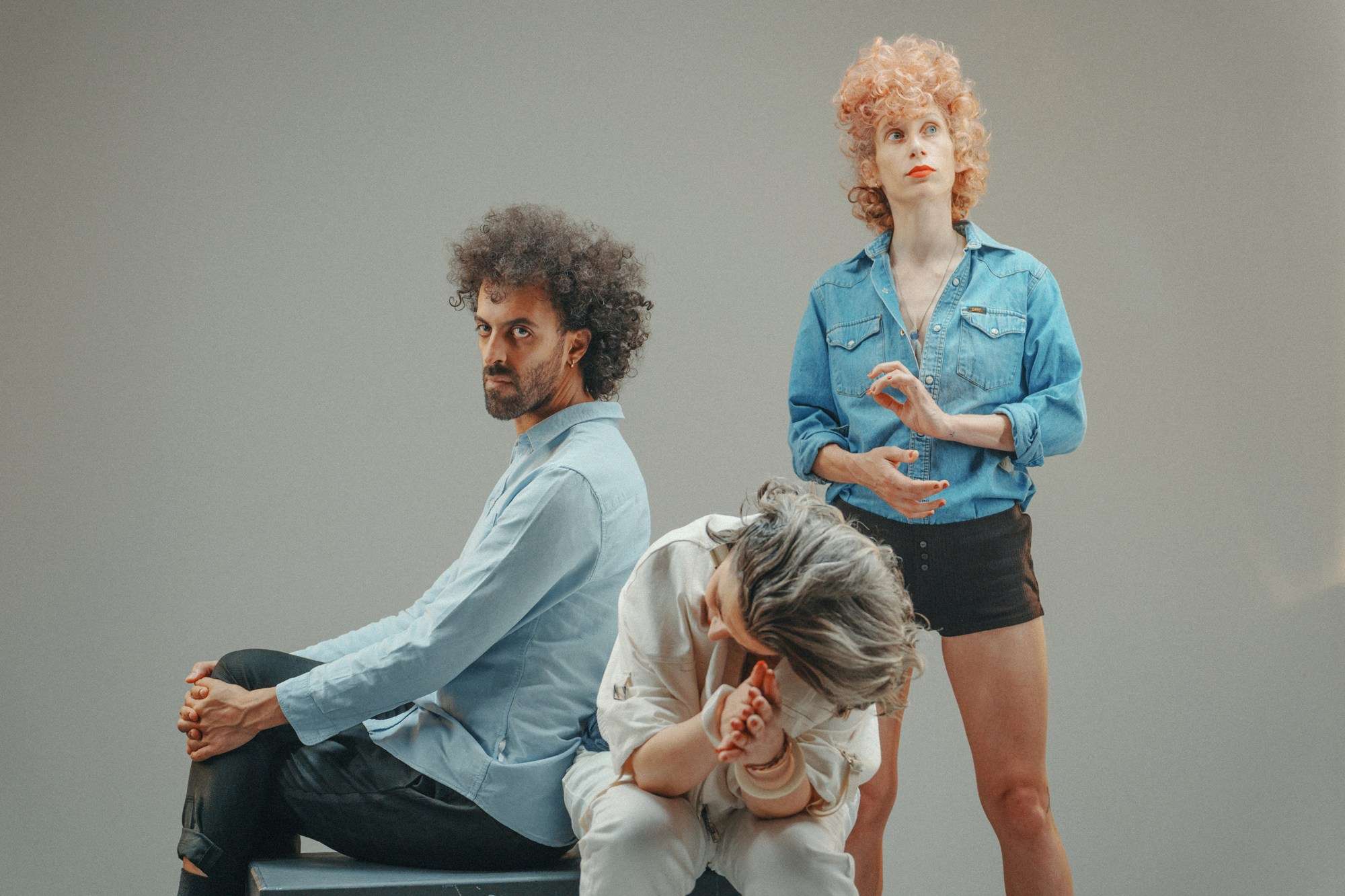
Strasbourg-born, Ankara-rooted trio Hermetic Delight are back with Vagabond Melodies — their most instinctive, grounded work yet.
The new album – released via October Tone – sheds concept and control, favouring pure emotion: songs that move like memory, equal parts noise and clarity, beauty and defiance.
Where 2020’s F.A. Cult (produced by Charles Rowell of Crocodiles) flirted with pop precision and cinematic edge, Vagabond Melodies feels more human — a diary written mid-storm.
From the fragile pulse of 9 Lives Have Gone By (a tribute to their late cat, Siouxsie) to the stormy undercurrent of Lust for Life, the record captures a band reshaping chaos into coherence.
We sat down with Zeynep Kaya, Delphine Padilla, and Atef Aouadhi to talk loss, resilience, and how Vagabond Melodies finds light in the noise — proof that survival, in music as in life, can still sound beautiful.
We don’t persist just for the sake of it, and we don’t bend to expectations either. We grow together, we make music together.
9 Lives Have Gone By pays tribute to your cat, Siouxsie, such a magnetic and unforgettable presence. Why did you choose to dedicate the whole album to his memory, and what did that trigger?
A: Actually, only 9 Lives is dedicated to him. But it opens the record because it feels like an introduction, like a shift. The album as a whole is more about life and loss, past and future, trials and resilience.
D: It was obvious for us to dedicate a song to him. Sioux was born at the same time as Hermetic Delight. Some of us even lived with him in a flatshare, and we all shared that relentless spirit.

Vagabond Melodies feels both sharper and more down-to-earth than your previous albums. What did you cut out, or refuse to compromise, to reach that clarity?
D: I think it’s more direct because it’s more honest. We went through a lot together these past years, and that brought us back to something essential.
A: And also, there was no concept behind it. We wrote song by song, without planning to make an album. The coherence came naturally, because we were only expressing what we were going through. With F.A. Cult, we really thought a lot about the form because, you know, it was the first album, we wanted it to be perfect and everything. This time, we just let the songs appear as they were.
Your sound has always moved between noise and shimmer. On this record, where did you embrace chaos, and where did you choose restraint?
A: For me, music was a way to contain the chaos around us. It was how we managed to channel it.
Z: With this album, we wanted to go back to our roots, even before F.A. Cult: noise, rock, guitars. We just wrote what made us move, without overthinking, and made sure the songs would keep — or even amplify — that energy on stage.
A: And there was also a real balance in the writing: guitars, bass, drums, keyboards… each of them found their own place. Nothing really took over, and that balance created the restraint.
D: Yes, and that’s really what defines us: every song holds both strength and delicacy. That’s our DNA.

Zeynep, your voice reshapes the songs around it — how do you decide when to stretch it and when to cut like a blade?
Z: Thank you. Honestly, it’s instinctive. I just let the music get inside me and I give it what comes from this very primal place. Sometimes it works, sometimes it doesn’t, but I trust the moment.
Delphine, your drumming has this choreographed, motorik precision. How much comes from discipline, and how much from instinct once a song is finished?
D: Atef once described me as “wild and disciplined,” and that really fits. My playing isn’t technical; I focus first on building a solid foundation. Then I like to add subtle details here and there. And the physical side is important too — if someone comes to me after a show and says, “It looked like you were dancing,” I love that. It means it felt alive, and that the audience was dancing with me in some way.
Atef, your guitars and bass seem to be in constant dialogue. Was that your intention from the start, or did this conversational style come with time?
A: Not really at first. On my demos, I used to put way too much — guitars and bass, all saturated, like a wall of sound. Over time, I learned to cut and strip things back, so the voices and other instruments could breathe. And when I miss a part too much, I recycle it into a vocal line, a harmony, or a keyboard part.
Over the years, you’ve gone from a dark shoegaze sound to a certain pop clarity. What did Charles Rowell’s production on F.A. Cult bring out that still resonates on Vagabond Melodies?
D: We keep stripping down more and more. Music needs silence.
A: And in the studio, I often caught myself thinking, “What would Charlie say here?” Sometimes I followed what I imagined he’d do, sometimes I did the opposite. Of course we sent him the songs. He’s never really far from us.
Hermetic Delight has been around long enough to see scenes appear and disappear. Do you see yourselves more as survivors, or as architects of your own path?
A: Both. Just existing is already a big deal. And from the beginning, we’ve never belonged to any category. Sure, we looked at what was considered “cool,” but we never copied. That singularity can be confusing, but it’s our strength.
D: Like everyone, we survive by moving forward. We set a course and we go for it.
Z: Yes, I agree. Being in a band is like a long-term relationship: you try not to go to bed angry. We love what we do, and we love doing it together. Long live rock’n roll!
Your new video, directed by Henri Gander, is both mesmerizing and cinematic. How did you want the images to amplify — or disrupt — the way the song is perceived?
A: I suggested to Henri that he could work with my personal videos of Siouxsie. But raw like that, it would just have looked like silly home videos. He reworked them, transformed them, and turned them into something cosmic, which perfectly matched what we wanted to express. I’m really grateful for that.
D: Yes, we gave him complete freedom. He based the visuals on a real picture of Siouxsie, and that gave the whole thing a tangible dimension.
If Vagabond Melodies is persistent, what is this persistence standing against: time, silence, or the weight of expectations?
D: For me, against time. Time always reveals more, that’s what I love about it.
A: For me, against hype and oblivion. Our lives are not special, but the things we went through were strong enough to leave a mark — just like everyone leaves their own.
Z: And there were strange coincidences too. We had recorded Lust for Life, and just before its release, I started cancer treatment. At that moment, I really didn’t want to put out a song with such a title. But once I was cured, we found the strength to release it. We don’t persist just for the sake of it, and we don’t bend to expectations either. We grow together, we make music together. I just hope this album finds its audience. It comes straight from the heart — from our shared experiences, our fears, our melancholy… but also from this unstoppable need to make some noise.
©fm